Thursday, November 14, 2019
History of Mt. Seven
Submitted by Scott Watwood,
adapted from ramblings of Peter Bowle-Evans and documentation from Garth Henderson.
The Mt. 7 lookout was built in the '50s for forest fire observation by the BC Forest Service. The old road (jeep road) to the Lookout was steep and narrow. Over the years the road was modestly improved for logging trucks and equipment a few kilometres at a time. This made parts of the road less steep and somewhat easier to negotiate. Despite these adjustments, the main road access to The Lookout, taken as a whole, remained a challenging 4X4 or heavy vehicle-only forestry track. The first significant improvement to the road occurred in mid-1990 with plans to reroute and re-engineer the road to serve as a forestry trunk road to connect to various higher-level branch roads. The plan and intent at the time were to access and harvest desirable stands of timber at various locations on the north shoulder of Mount 7.
In 1990, Willi Muller taught Golden resident, Peter Bowle-Evans, how to hang glide and advised him on solidifying Mt.7 as a significant, foot-launched flying site. An enthusiastic Peter embraced this concept fully and proceeded to secure the Lookout site by obtaining a government-issued Special Use Permit. As partly documented below, Peter then proceeded to initiate major improvements to the site and was at the forefront of developing flyer-friendly relationships with authorities in town and with landowners at the landing zone as well as landowners downrange. Peter was among the first to envision the potential for Golden to become a broad-based "adventure tourism" destination with attendant financial spinoffs for the community.
By the mid-1990s, Peter Bowle-Evans, a very community-engaged and enthusiastic hang glider pilot had, for about 5 years, been the de-facto Mt. 7 flying site development leader and main Forestry liaison person. Through his job with an engineering firm in Golden, he was in constant contact and working with local Forestry officials on a weekly if not daily basis. Peter, was instrumental in making sure that the interests of the Mt.7 flying community were brought to the forefront of the planning & construction of the "new" Mt.7 Lookout access road. As the '90 drew to a close, the last logging cut-block was laid out and the new road ended at 11.7 km. At the time, Peter Bowle Evans negotiated to extend the new road all the way to The Lookout site. In fact, the final 3 kilometres of the road was only completed because Peter cajoled Forestry officials ceaselessly and brought to bear a significant financial contribution from the Mt. 7 Flying Site Fund. At the same time, Peter coordinated and contributed Flying site funds for the use of heavy construction equipment to grade and improve both the south and north side launches at The Lookout. (the south side was formerly a rocky cliff backed by a steep rough slope) All of this was completed by the end of 2000.
Later Peter worked with Forestry to approve and acquire the components for the top outhouse. To get this facility built, Peter recruited a construction party made up of volunteers - four pilots and 1 local mountain bike enthusiast. The materials were trucked to the top by local businessman & paraglider pilot, Flec Demmon, who owned Golden Truss Products and a crane truck. Since the road completion in 2000 and other subsequent improvements, there has been a huge increase in the number of visitors to The Lookout (visitors of all types - wedding parties to tourist sightseers in addition to pilots and mountain bikers.) Beyond the new road construction, it should be noted that Peter Bowle-Evans continued to lead the development of the Lookout for many years until his untimely death in an avalanche. In recognition of his nearly 20-year involvement and contribution to the Mt.7 Lookout as an important attraction/asset for the town, the road now carries his name - The Bowle-Evans FSR.
The first hang glider pilot, Alan Kane, launched from Mt.7 in 1974. George Wells, a fondly remembered Mt. 7 shuttle driver who lived most of his life across the road from the LZ, recalled that day when his came kids running into the house screaming that "someone was flying without an engine". As hang gliding became more popular, the pioneers of that sport noticed the potential of the Lookout site and started to clear a few trees in the mid 80's. The clearing was undertaken to make launching hang gliders safer. Two launch ramps were also constructed for the same safety reasons. The site subsequently began to develop a higher profile as a premier mountain launch site, particularly for those pilots who wanted to pursue the nascent practice of flying cross-country. The recognition of the foot-launched flight potential of Mt.7 was partly due to the interest in the site by Willi Muller. Willi operated a Hang Gliding and, later, a Paragliding School on his property at the Cochrane Hill in Alberta. As a hang gliding pioneer, Willi Muller was often referred to as "The Father of Hang Gliding in Canada". His promotion of Mt.7 through his business activities had a lot to do with the international "discovery" of Mt.7 as a world-class Hang Gliding and Paragliding destination.
The first paraglider launch from The Lookout was made by Chris Muller in 1989. The only available moderately safe space for launching was straight off the west-facing ramp. At the time paragliding was a new sport from Europe that was just starting to reach Canada. The first cross-country paraglider flight launching from the Lookout was made July 21st, 1990 by Sean Dougherty. On July 7th, 1991, Sean flew with Willi & Chris Muller down the range. All three achieving 100k flights. Chris and Sean were awarded a world record for their flights to a declared goal. Regrettably, Willi didn't declare or take a barograph so he could not apply for the record. Word of Golden's Mt.7 as a fantastic XC site began to spread internationally in concert with an explosive growth through the '90s of paragliding as a new form of aviation. At the time the upper launch was heavily used by paragliders pending the development of the Lookout into a more paraglider friendly launch.
The growth of paragliding and influx of paraglider pilots to Mt7 though the '90s was phenomenal. Word of Mt.7 in Golden, Canada has spread far and wide as a place where personal best distances can be achieved because of the excellent thermal conditions at launch and down-valley. Every year pilots arrived in Golden from far away points in Western Europe, Eastern Europe, Russia, Japan, New Zealand and the US. World Champions have visited and flown here including former World Champion, Robbie Whittal and Swiss Champion & current equipment manufacturer Urs Harri. Over the years Mt. 7 has hosted numerous National Championships and Western Canadian Championships in Hang gliding and paragliding. Many "first flight" XC routes originated from Mt.7 including first-ever paragliding flight over the Rockies to Canmore, Alberta. It is world-renowned as one of the top sites in the world. There have been 8 world records set here. The first world record was set in 1986 by Randy Haney. He flew 321 km on a hang glider. Although the nationals are not being held here every year there is an annual fly-in/competition, the Willi Muller memorial event, that will see 120 competitors and their entourages arrive in town to spend 10 days of intensive distance flying. In addition, as soon as the site opens, usually the 1st week of June, there is a steady influx of visiting pilots on weekends throughout the summer and well into the fall. July 15 to August 15 is peak XC season and even weekdays can be busy with vacationing pilots and tourists seeking tandem rides.
In the late '90s, a local mountain biking race was run. Mt. 7 psychosis started out with a few racers and $100 prize money. It grew into a huge, world-famous Redbull event with over 200 riders and $15,000 prize in the tenth and final year. There was also a world record for vertical meters biked in 24 hours set there.
The Mount 7 site has developed into a true & vital community asset that has contributed to Golden's attempts to diversify and grow its local economy.
More site info at flygolden.ca and mt7.ca.

Saturday, April 27, 2019
A few oldies from the early days
Southern Okanagan early days
 Anarchist Mtn 1975
 Training hill in Kaleden
 My buddy Murray Harris ( Seagull ) and myself ( Eagle Cloud ) at Lower Cawston 1977
 Training my Ma 1976
 I believe this to be Barry Howie (Mirage ) 1977
 Stewart Midwinter 1977 Glider?
 Myself Anarchist Mtn ( Eagle Cloud ) 1977
 Keith McKinnon ( 1980 Comet ) one of the first double surface gliders I believe
 Anarchist Mtn 1975
 Training hill in Kaleden
 My buddy Murray Harris ( Seagull ) and myself ( Eagle Cloud ) at Lower Cawston 1977
 Training my Ma 1976
 I believe this to be Barry Howie (Mirage ) 1977
 Stewart Midwinter 1977 Glider?
 Myself Anarchist Mtn ( Eagle Cloud ) 1977
 Keith McKinnon ( 1980 Comet ) one of the first double surface gliders I believe
Friday, April 12, 2019
Grouse Mountain Meet 1976
In late summer 1976, I tagged along with a group of pilots from Calgary (one of whom, cam Wilson, decided along the way to start calling me 'midtoad') for the long drive to Vancouver BC, where the international invitational Grouse Mountain Meet was about to start. I didn't have enough experience to enter as a competitor, but I sure enjoyed watching the pilots and taking pictures. It seemed like all the loyalty of hang gliding was there at the comp. This was the first time I met Larry Tudor, among others.
On the first day, the clouds hung low around the Summit launch, but the sun began to breakthrough in late afternoon. This gave me a great opportunity to capture on film the variety of wings as the pilots launched.
On the first day, the clouds hung low around the Summit launch, but the sun began to breakthrough in late afternoon. This gave me a great opportunity to capture on film the variety of wings as the pilots launched.
 |
| waiting on the ramp |
 | |
| Crowded setup area |
 | |
| Gord Acri plays banjo for Larry Tudor, ?, Gord Savage |
 |
| Edmontonian Larry Croome resting up |
 |
| Larry Croome and Birdman MJ-4 |
 |
| Albatross Sail Gliders ASG-21 |
 |
| Swansea HG Corp pilot Jeff Blake and Oly 160 |
 |
| Invermere pilot John Duthie and Phoenix 8 |
 | |
| Kaslo, BC pilot Randy Cairns and UP Dragonfly |
 | |
| UP Spyder |
 |
| Invermere pilot Dean Kupchanko and Oly 140 |
 | |
| Australian-made Lancer 4 |
 | |
| Electra-Flyer Cirrus 3 |
 | ||
| A bearded Don Miller advising pilot on ramp |
 | |
| Spectators en masse |
 | |
| Seagull 7 in evening flight |
Friday, April 5, 2019
Ottawa-area flying in 1975
Hang gliding really started in the Ottawa Valley when pilot name Bob Johannsen started a school with gliders from Muller Kites. I knew about the sport after reading an article in Esq. magazine in the summer of 1974. At Carleton University, where I was entering second year, I spotted posters advertising lessons for the enormous sum of $35. Somehow I scrounged together the cash and took my first lesson on October 23 call stack year.
By the following summer, I had made several high flights at King Mountain in Gatineau Park but still returned to my training slope at Edelweiss ski hill in Québec when the wind direction was right. Here are some pictures I took at that time of my instructor Chris Mills, who coincidentally was a fellow student at my high school.
By the following summer, I had made several high flights at King Mountain in Gatineau Park but still returned to my training slope at Edelweiss ski hill in Québec when the wind direction was right. Here are some pictures I took at that time of my instructor Chris Mills, who coincidentally was a fellow student at my high school.
 |
| Chris Mills flying at Edelweiss ski hill |
 |
| Chris Mills flying down Intermediate ski run |
 |
| Chris Mills after launch with his Muller 1817 at King Mtn. |
 |
| Chris flying out to the LZ below King Mtn. |
Monday, February 25, 2019
A brief history of Mount Seven
History of Mt. 7
The Mt. 7 lookout was built in the 50's for forest fire observation by the
BC Forest Service. The old road (jeep road) to the Lookout was steep and
narrow. Over the years the road was modestly improved for logging trucks
and equipment a few kilometers at a time, and this made parts of the road less
steep and somewhat easier to negotiate. Despite these adjustments, the main
road access to The Lookout, taken as a whole, remained a challenging 4X4 or
heavy vehicle-only forestry track. The first significant improvement to the
road occurred in mid-1990 with plans to reroute and re-engineer the road to
serve as a forestry trunk road to connect to various higher level branch
roads. The plan and intent at the time was to access and harvest desireable
stands of timber at various locations on the north shoulder of Mount 7.
Mt.7 Flying Site Involvement
In 1990 Willi Muller taught Golden resident, Peter Bowle-Evans how to hang
glide and advised him on solidifying Mt.7 as a significant, foot-launched
flying site. An enthusiastic Peter embraced this concept fully and
proceeded to secure the Lookout site by obtaining a government issued
Special Use Permit. As partly documented below, Peter then proceeded to
initiate major improvements to the site and was at the forefront of
developing flyer-friendly relationships with authorities in town and with
land owners at the landing zone as well as land owners down range. Peter
was among the first to envision the potential for Golden to become a
broad-based "adventure tourism" destination with attendant financial
spinoffs for the community.
By the mid-1990's, Peter Bowle-Evans, a very community-engaged and
enthusiastic hang glider pilot had, for about 5 years, been the defacto Mt.
7 flying site development leader and main Forestry liaison person. Through
his job with an engineering firm in Golden he was in constant contact and
working with local Forestry officials on a weekly if not daily basis.
Peter, was instrumental in making sure that the interests of the Mt.7
flying community were brought to the forefront of the planning &
construction of the "new" Mt.7 Lookout access road. As the 90's drew to a
close, the last logging cutblock was laid out and the new road ended at
11.7 kms. At the time, Peter Bowle Evans, negotiated to extend the new road
all the way to The Lookout site. In fact, the final 3 kilometers of the
road were only completed because Peter cajoled Forestry officials
ceaselessly and brought to bear a significant financial contribution from
the Mt.7 Flying Site Fund. At the same time Peter coordinated and
contributed Flying site funds for the use of heavy construction equipment
to grade and improve both the south and north side launches at The
Lookout.(the south side was formerly a rocky cliff backed by a steep rough
slope) All of this was completed by the end of 2000.
Later Peter worked with Forestry to approve and acquire the components for
the top outhouse. To get this facility built, Peter recruited a
construction party made up of volunteers - four pilots and 1 local mountain
bike enthusiast. The materials were trucked to the top by local businessman
& paraglider pilot, Flec Demmon, who owned Golden Truss Products and a
crane truck. Since the road completion in 2000 and other subsequent
improvements, there has been a huge increase in the number of visitors to
The Lookout (vistors of all types - wedding parties to tourist sightseers
in addition to pilots and mountain bikers.) Beyond the new road
construction it should be noted that Peter Bowle-Evans continued to lead
development of the Lookout for many years until his untimely death in an
avalanche. In recognition of his nearly 20 year involvement and
contribution to the Mt.7 Lookout as an important attaction/asset for the
town, the road now carries his name - The Bowle-Evans FSR.
Mount 7 - Adventure Sport Destination
The first hang glider pilot, Alan Kane, launched from Mt.7 in 1974. George
Wells, a fondly remembered Mt. 7 shuttle driver, recalled that day when his
came kids running into the house screaming that "someone was flying without
an engine". As hang gliding became more popular, the pioneers of that sport
noticed the potential of the Lookout site and started to clear a few trees
in the mid 80's. The clearing was undertaken to make launching hang gliders
safer. Two launch ramps were also constructed for the same safety reasons.
The site subsequently began to develop a higher profile as a premiere
mountain launch site, particularly for those pilots who wanted to pursue
the nacent practice of flying cross-county. The recognition of the
foot-launched flight potential of Mt.7 was partly due to the interest in
the site by Willi Muller. Willi operated a Hang Gliding and, later, a
Paragliding School on his property at the Cochrane Hill in Alberta. As a
hang gliding pioneer, Willi Muller was often referred to as "The Father of
Hang Gliding in Canada". His promotion of Mt.7 through his business
activities had a lot to do with the international "discovery" of Mt.7 as a
world-class Hang Gliding and Paragliding destination.
The first paraglider launch from The Lookout was made by Chris Muller in
1989. The only available moderately safe space was straight off the west
facing ramp. At the time paragliding was a new sport from Europe that was
just starting to reach Canada. The first cross-country paraglider flights
launching from the Lookout were made in 1989/90 by Willi & Chris Muller and
Sean Doherty. With Willi & Chris Muller both achieving 100k flights in
1990, word of Golden's Mt.7 as a fantastic XC site began to spread
internationally in concert with an explosive growth through the 90's of
paragliding as a new form of aviation. At the time the upper launch was
heavily used by paragliders pending the development of the Lookout into a
more paraglider friendly launch.
The growth of paragliding and influx of paraglider pilots to Mt7 though the
90's was phenomenal. Word of Mt.7 in Golden, Canada has spread far and wide
as a place where personal best distances can be achieved because of the
excellent thermal conditions at launch and down-valley. Every year pilots
arrived in Golden from far away points in Western Europe, Eastern Europe,
Russia, Japan, New Zealand and the US. World Champions have visited and
flown here including former World Champion, Robbie Whittal and Swiss
Champion & current equipment manufacturer Urs Harri. Over the years Mt. 7
has hosted numerous National Championships and Western Canadian
Championships in Hang gliding and paragliding. Many "first flight" XC
routes originated from Mt.7 including first ever paragliding flight over
the Rockies to Canmore, Alberta. It is world reknowned as one of the top
sites in the world. There have been 8 world records set here. The first
world record was set in 1986 by Randy Haney. He flew 321 kms on a hang
glider. Although the nationals are not being held here every year there is
an annual flyin/competiton, the Willi Muller memorial event, that will see
120 competitiors and their entourages arrive in town to spend 10 days of
intensive distance flying. In addition, as soon as the site opens, usually
the 1st week of June, there is a steady influx of visiting pilots on
weekends throughout the summer and well into the fall. July 15 to August 15
is peak XC season and even weekdays can be busy with vacationing pilots and
tourists seeking tandem rides.
In the late 90's a local mountain biking race was run. Mt. 7 psychosis
started out with a few racers and $100 prize money. It grew into a huge
world famous event with over 200 riders and $15,000 prize in the tenth and
final year. There was also a world record for vertical meters biked in 24
hours set here.
The Mount 7 site has developed into a true & vital community asset that has
contributed to Golden's attempts to diversify and grow its local economy.
Submitted by Scott Watwood, adapted from ramblings of Peter Bowle-Evans and
Garth Henderson.
Regards,
Scott Watwood | scottwatwood@persona.ca
Note: This email was sent via the Contact Form gadget on
https://canadian-hgpghistory.b
The Mt. 7 lookout was built in the 50's for forest fire observation by the
BC Forest Service. The old road (jeep road) to the Lookout was steep and
narrow. Over the years the road was modestly improved for logging trucks
and equipment a few kilometers at a time, and this made parts of the road less
steep and somewhat easier to negotiate. Despite these adjustments, the main
road access to The Lookout, taken as a whole, remained a challenging 4X4 or
heavy vehicle-only forestry track. The first significant improvement to the
road occurred in mid-1990 with plans to reroute and re-engineer the road to
serve as a forestry trunk road to connect to various higher level branch
roads. The plan and intent at the time was to access and harvest desireable
stands of timber at various locations on the north shoulder of Mount 7.
Mt.7 Flying Site Involvement
In 1990 Willi Muller taught Golden resident, Peter Bowle-Evans how to hang
glide and advised him on solidifying Mt.7 as a significant, foot-launched
flying site. An enthusiastic Peter embraced this concept fully and
proceeded to secure the Lookout site by obtaining a government issued
Special Use Permit. As partly documented below, Peter then proceeded to
initiate major improvements to the site and was at the forefront of
developing flyer-friendly relationships with authorities in town and with
land owners at the landing zone as well as land owners down range. Peter
was among the first to envision the potential for Golden to become a
broad-based "adventure tourism" destination with attendant financial
spinoffs for the community.
By the mid-1990's, Peter Bowle-Evans, a very community-engaged and
enthusiastic hang glider pilot had, for about 5 years, been the defacto Mt.
7 flying site development leader and main Forestry liaison person. Through
his job with an engineering firm in Golden he was in constant contact and
working with local Forestry officials on a weekly if not daily basis.
Peter, was instrumental in making sure that the interests of the Mt.7
flying community were brought to the forefront of the planning &
construction of the "new" Mt.7 Lookout access road. As the 90's drew to a
close, the last logging cutblock was laid out and the new road ended at
11.7 kms. At the time, Peter Bowle Evans, negotiated to extend the new road
all the way to The Lookout site. In fact, the final 3 kilometers of the
road were only completed because Peter cajoled Forestry officials
ceaselessly and brought to bear a significant financial contribution from
the Mt.7 Flying Site Fund. At the same time Peter coordinated and
contributed Flying site funds for the use of heavy construction equipment
to grade and improve both the south and north side launches at The
Lookout.(the south side was formerly a rocky cliff backed by a steep rough
slope) All of this was completed by the end of 2000.
Later Peter worked with Forestry to approve and acquire the components for
the top outhouse. To get this facility built, Peter recruited a
construction party made up of volunteers - four pilots and 1 local mountain
bike enthusiast. The materials were trucked to the top by local businessman
& paraglider pilot, Flec Demmon, who owned Golden Truss Products and a
crane truck. Since the road completion in 2000 and other subsequent
improvements, there has been a huge increase in the number of visitors to
The Lookout (vistors of all types - wedding parties to tourist sightseers
in addition to pilots and mountain bikers.) Beyond the new road
construction it should be noted that Peter Bowle-Evans continued to lead
development of the Lookout for many years until his untimely death in an
avalanche. In recognition of his nearly 20 year involvement and
contribution to the Mt.7 Lookout as an important attaction/asset for the
town, the road now carries his name - The Bowle-Evans FSR.
Mount 7 - Adventure Sport Destination
The first hang glider pilot, Alan Kane, launched from Mt.7 in 1974. George
Wells, a fondly remembered Mt. 7 shuttle driver, recalled that day when his
came kids running into the house screaming that "someone was flying without
an engine". As hang gliding became more popular, the pioneers of that sport
noticed the potential of the Lookout site and started to clear a few trees
in the mid 80's. The clearing was undertaken to make launching hang gliders
safer. Two launch ramps were also constructed for the same safety reasons.
The site subsequently began to develop a higher profile as a premiere
mountain launch site, particularly for those pilots who wanted to pursue
the nacent practice of flying cross-county. The recognition of the
foot-launched flight potential of Mt.7 was partly due to the interest in
the site by Willi Muller. Willi operated a Hang Gliding and, later, a
Paragliding School on his property at the Cochrane Hill in Alberta. As a
hang gliding pioneer, Willi Muller was often referred to as "The Father of
Hang Gliding in Canada". His promotion of Mt.7 through his business
activities had a lot to do with the international "discovery" of Mt.7 as a
world-class Hang Gliding and Paragliding destination.
The first paraglider launch from The Lookout was made by Chris Muller in
1989. The only available moderately safe space was straight off the west
facing ramp. At the time paragliding was a new sport from Europe that was
just starting to reach Canada. The first cross-country paraglider flights
launching from the Lookout were made in 1989/90 by Willi & Chris Muller and
Sean Doherty. With Willi & Chris Muller both achieving 100k flights in
1990, word of Golden's Mt.7 as a fantastic XC site began to spread
internationally in concert with an explosive growth through the 90's of
paragliding as a new form of aviation. At the time the upper launch was
heavily used by paragliders pending the development of the Lookout into a
more paraglider friendly launch.
The growth of paragliding and influx of paraglider pilots to Mt7 though the
90's was phenomenal. Word of Mt.7 in Golden, Canada has spread far and wide
as a place where personal best distances can be achieved because of the
excellent thermal conditions at launch and down-valley. Every year pilots
arrived in Golden from far away points in Western Europe, Eastern Europe,
Russia, Japan, New Zealand and the US. World Champions have visited and
flown here including former World Champion, Robbie Whittal and Swiss
Champion & current equipment manufacturer Urs Harri. Over the years Mt. 7
has hosted numerous National Championships and Western Canadian
Championships in Hang gliding and paragliding. Many "first flight" XC
routes originated from Mt.7 including first ever paragliding flight over
the Rockies to Canmore, Alberta. It is world reknowned as one of the top
sites in the world. There have been 8 world records set here. The first
world record was set in 1986 by Randy Haney. He flew 321 kms on a hang
glider. Although the nationals are not being held here every year there is
an annual flyin/competiton, the Willi Muller memorial event, that will see
120 competitiors and their entourages arrive in town to spend 10 days of
intensive distance flying. In addition, as soon as the site opens, usually
the 1st week of June, there is a steady influx of visiting pilots on
weekends throughout the summer and well into the fall. July 15 to August 15
is peak XC season and even weekdays can be busy with vacationing pilots and
tourists seeking tandem rides.
In the late 90's a local mountain biking race was run. Mt. 7 psychosis
started out with a few racers and $100 prize money. It grew into a huge
world famous event with over 200 riders and $15,000 prize in the tenth and
final year. There was also a world record for vertical meters biked in 24
hours set here.
The Mount 7 site has developed into a true & vital community asset that has
contributed to Golden's attempts to diversify and grow its local economy.
Submitted by Scott Watwood, adapted from ramblings of Peter Bowle-Evans and
Garth Henderson.
Regards,
Scott Watwood | scottwatwood@persona.ca
Note: This email was sent via the Contact Form gadget on
https://canadian-hgpghistory.b
 |
Wednesday, January 30, 2019
First high flight, Cornwall BC 1979
BC pilot Bob Krider sends this:
"My pioneering flight off Cornwall in 1979, after one year of flying. That was a rush. Sooooo high. I yelled insults at the tiny little cows below me for being stuck to the ground. The flight was heavily covered by the local press (front page news).
I got rid of that huge Electra Flyer Floater, which liked to spin at the slightest provocation. Moved to England in 1980. By then I had a couple hours total airtime, so figured I was ready for the new double surface fad, and upgraded to a double surface Airwaves Comet in 1981. I only destroyed one Comet before I got the hang of it."
"My pioneering flight off Cornwall in 1979, after one year of flying. That was a rush. Sooooo high. I yelled insults at the tiny little cows below me for being stuck to the ground. The flight was heavily covered by the local press (front page news).
I got rid of that huge Electra Flyer Floater, which liked to spin at the slightest provocation. Moved to England in 1980. By then I had a couple hours total airtime, so figured I was ready for the new double surface fad, and upgraded to a double surface Airwaves Comet in 1981. I only destroyed one Comet before I got the hang of it."
 |
| Ashcroft Journal 1979-09-12 pg.1 |
 | |
| Ashcroft Journal 1979-09-12 pg.2 |
Tuesday, January 29, 2019
Early Prairie PG XC flights
By the late 1980s, it was understood by hang glider pilots that the days after a cold front were ideal for cross country flying. But in Alberta, at least in the area around Calgary, there were a few good north west or north facing sites. One emerging option was a 60m-high bowl called The Bridge along Highway 552 at the Sheep River near its confluence with the Bow River, SE of Calgary. The landowner had allowed hang glider pilots to fly there on occasion , and they did. But the hillside was covered in bushes which made it difficult to walk up if you sank out to the bottom. Paragliders had an advantage in that they could fly in lighter winds and could walk up more easily with their gear. One pilot that was soon taking advantage of this was Sean Dougherty, an accomplished mountaineer that had entered the sport. After a few tries, the managed to get up and away and flew around 50km all the way to Nanton, a record. There, he landed in a wind that was so strong that he would have been blown backwards with a normal approach. Instead, he flew downwind till Close to the ground, then made a sharp, high-speed, High G turn, which momentarily gave him enough ground speed to touch down safely.
On a later occasion, flying at the site, he drifted away quite low and experienced turbulence that dropped him into a farm field where he broke several bones. He was lucky to be spotted by a passer by and spend sometime in the hospital.
In this photo, I've captured him flying an Apco Hilite at The Bridge site one fine October day in 1991.
On a later occasion, flying at the site, he drifted away quite low and experienced turbulence that dropped him into a farm field where he broke several bones. He was lucky to be spotted by a passer by and spend sometime in the hospital.
In this photo, I've captured him flying an Apco Hilite at The Bridge site one fine October day in 1991.
 |
| Sean Dougherty at The Bridge |
Thursday, January 24, 2019
1982 HG Nationals
In 1982, the Canadian national hang gliding championship was held in Sicamous, BC. The roughly 2000 foot high south facing launch was chosen because its beach landing area and close proximity to a town.
The competition winner was BC pilot Jim Bamford. He flew a UP Comet 185 - a new, larger size that had just become available. With his light weight of around 135 pounds, he could easily have flown the smallest size, but in the light conditions prevalent at this site, he enjoyed a very low sink rate and a huge advantage over other pilots.
By the following year, many other pilots had adopted the larger size as well, including myself. By then, there was a newer model, the Comet 2. It had a better glide ratio, but was harder to turn, so having a low wind loading by then was no longer such an advantage. Eventually pilots all migrated to smaller gliders. But by then the competitions were focusing on cross-country flying, where the higher speed associated with a higher wing loading became an advantage.
1st Jim Bamford, 2nd Jeff Blake, BC; 3rd Rick Mercer, AB; 4th Tony Schmidt, BC; 5th Howard Vandall, AB; 6th Rob Sinclair, 7th Lloyd Matthews, BC; 8th Bruce Galloway, AB; 9th Bob Yarnton, SK;. Missing: 10th Ken Hiebert.
The competition winner was BC pilot Jim Bamford. He flew a UP Comet 185 - a new, larger size that had just become available. With his light weight of around 135 pounds, he could easily have flown the smallest size, but in the light conditions prevalent at this site, he enjoyed a very low sink rate and a huge advantage over other pilots.
By the following year, many other pilots had adopted the larger size as well, including myself. By then, there was a newer model, the Comet 2. It had a better glide ratio, but was harder to turn, so having a low wind loading by then was no longer such an advantage. Eventually pilots all migrated to smaller gliders. But by then the competitions were focusing on cross-country flying, where the higher speed associated with a higher wing loading became an advantage.
 | |
| Top 10 pilots at the 1982 nationals |
1st Jim Bamford, 2nd Jeff Blake, BC; 3rd Rick Mercer, AB; 4th Tony Schmidt, BC; 5th Howard Vandall, AB; 6th Rob Sinclair, 7th Lloyd Matthews, BC; 8th Bruce Galloway, AB; 9th Bob Yarnton, SK;. Missing: 10th Ken Hiebert.
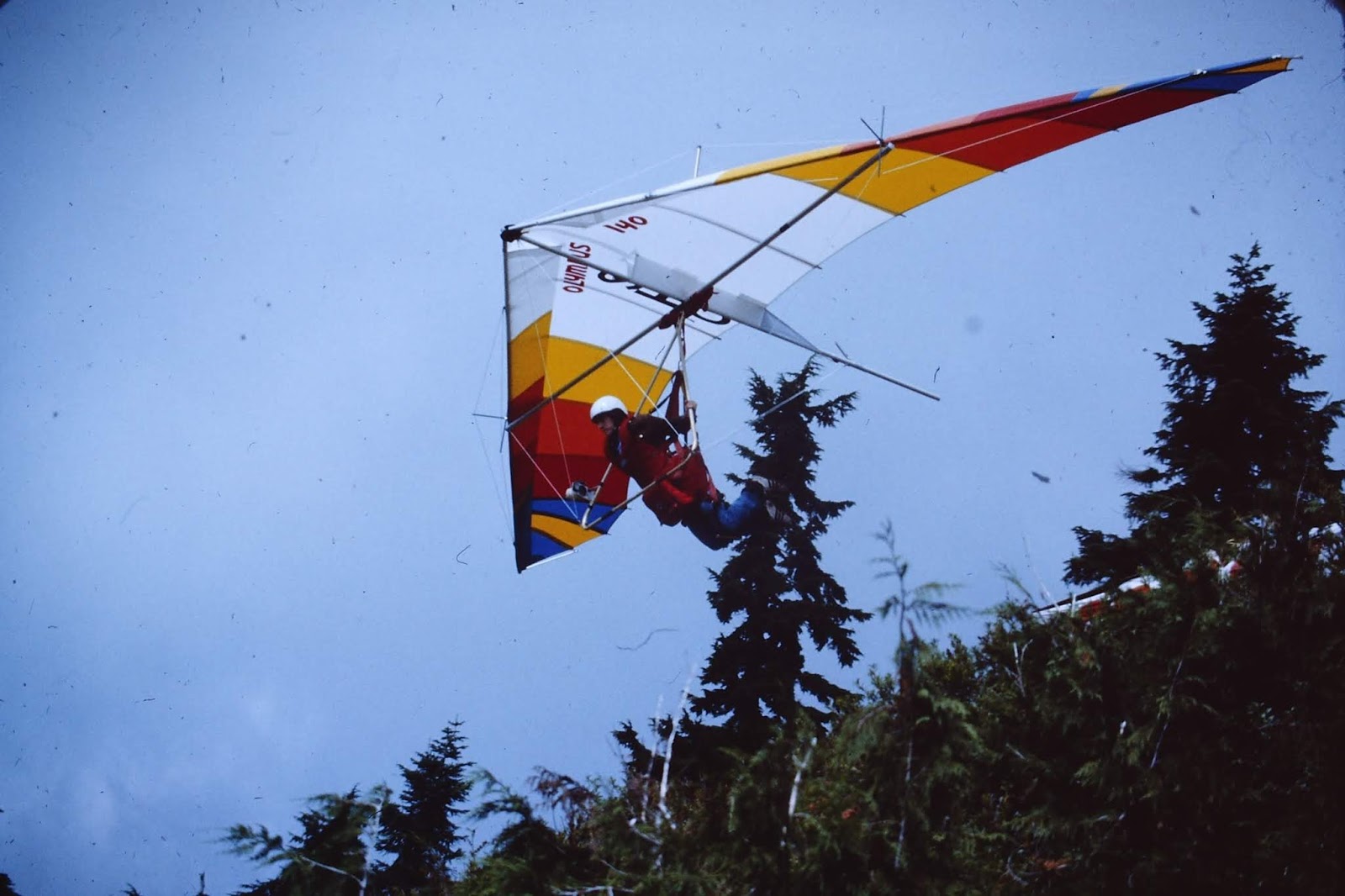
Flying at Wilmer, BC
Along the shores of Lake Windermere, near Invermere BC, prehistoric riverbanks rise up to 60 m or more above today's water levels. Just north of town, along the edge of the Columbia River wetlands, a section of steep riverbank sticks out into the middle of the valley. This hillside deflects infrequent strong southerly winds creating soaring conditions for pilots. Wind speed and direction have to be just perfect, however, since there is no real bottom landing area and few options on top as well. But in the mid-1970s, eager local pilots found the ideal times to fly this site. Here's a post from one of them, Jeff Blake, AKA "the king of Invermere".
"Testing the little rocket ship, a 140 Olympus at Wilmer BC -- and the crowd was wild, Great days."
Photo by Pat Morrow.

"Testing the little rocket ship, a 140 Olympus at Wilmer BC -- and the crowd was wild, Great days."
Photo by Pat Morrow.

Thursday, January 17, 2019
More from 1980 Canadian HG nationals
In a recent post, Doug Keller posted some pictures from the 1980 national championship. One of them was of me with beer poured in my hair to celebrate setting the Canadian duration record. I went back to my logbooks and found my log book entries for that flight.
At that time of that flight, there was no official Canadian log book. I used a surveyor's notebook because it was sturdy and with good quality paper. Many of us wrote at length about our flights, as each one was a huge learning adventure, and a real gift. In later years, I gradually wrote less and less, and eventually only made short entries in an online notebook. But I continued to log each and every flight, not just because it is required by our rating system, but because it was personally meaningful.
When I took up flying sailplanes in 1987, I noted carefully the soaring association's official log book design, and used it as inspiration for the first official HPAC hardcover logbook.
To the reader: did you use to keep a logbook and log every flight? Do you still use a logbook or have you given it up? If the latter, what led to that?
At that time of that flight, there was no official Canadian log book. I used a surveyor's notebook because it was sturdy and with good quality paper. Many of us wrote at length about our flights, as each one was a huge learning adventure, and a real gift. In later years, I gradually wrote less and less, and eventually only made short entries in an online notebook. But I continued to log each and every flight, not just because it is required by our rating system, but because it was personally meaningful.
When I took up flying sailplanes in 1987, I noted carefully the soaring association's official log book design, and used it as inspiration for the first official HPAC hardcover logbook.
To the reader: did you use to keep a logbook and log every flight? Do you still use a logbook or have you given it up? If the latter, what led to that?
 |
| logbook entry for Cdn. Duration reccord |
 | |
| 2 Electra-Flier Spirits; photo by Graydon Tranquilla |
Here is an in-flight photo taken by Graydon Tranquilla. It shows two Electric-flyer Spirits, which were very popular with the Alberta team as Willi Muller sold them. You can get a good idea of how steep the cliff is below the takeoff spot. Launching in strong winds was exciting, to put it mildly.
Subscribe to:
Posts (Atom)
-
 Hang gliding really started in the Ottawa Valley when pilot name Bob Johannsen started a school with gliders from Muller Kites. I knew about...
 -
 In late summer 1976, I tagged along with a group of pilots from Calgary (one of whom, cam Wilson, decided along the way to start calling me ...
 -
Submitted by Scott Watwood, adapted from ramblings of Peter Bowle-Evans and documentation from Garth Henderson. The Mt. 7 lookout was bui...